Jan Rupert Art Centre
Faces of Modernism
20th-century portraits and figures
15 November 2025 - 27 November 2026
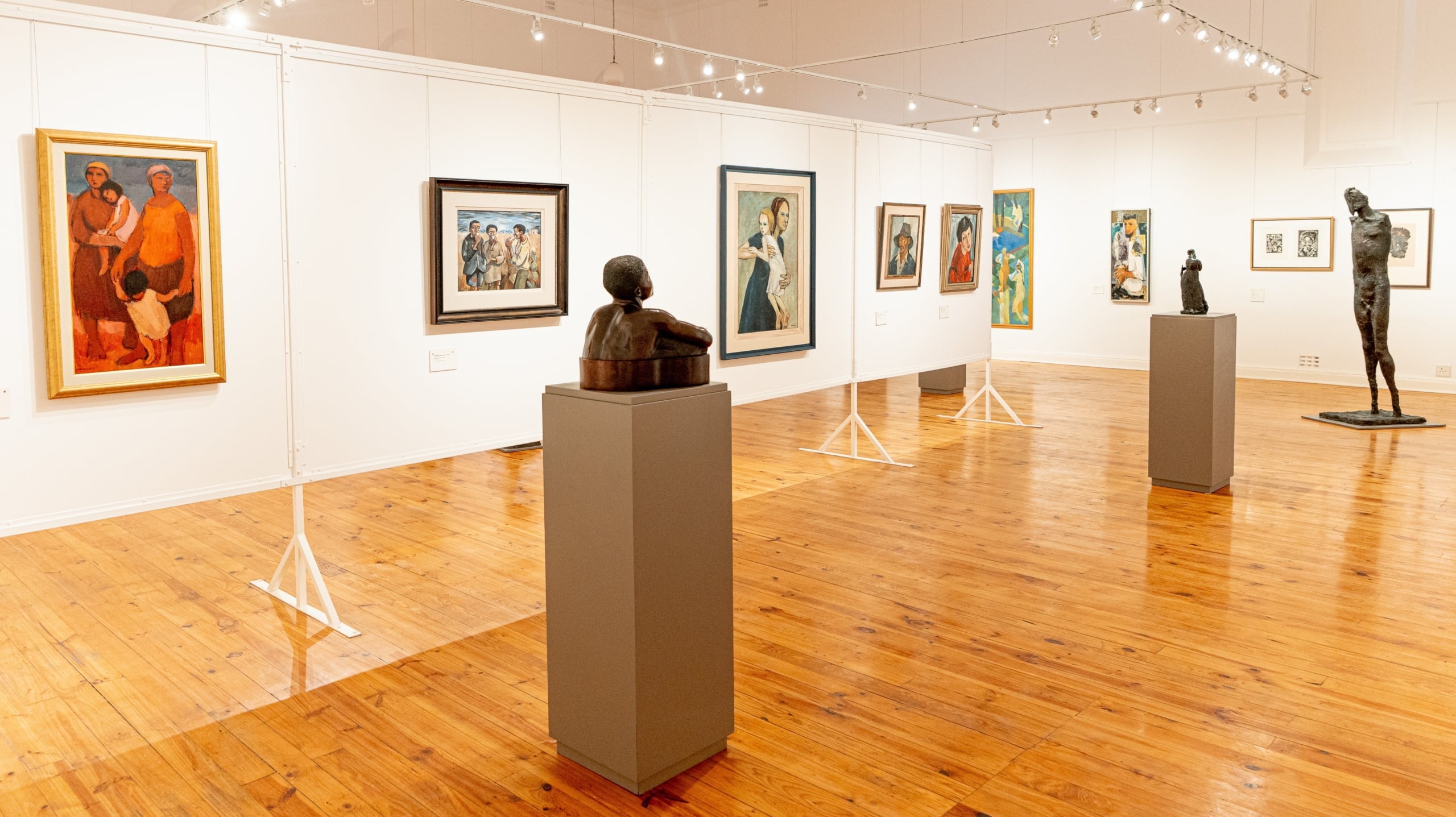
The Modern Movement emerged in the 1860s, fuelled by the energy of the Industrial Revolution and forever shaped by two World Wars. It sprang from a powerful desire to respond to a rapidly evolving world, but its arrival in South Africa would come later, only in the late 1920s. South African artists, eager for inspiration and learning, journeyed abroad and found themselves swept up in the daring spirit of the European avant-garde movements like Cubism, Impressionism, Post-Impressionism, Expressionism, Fauvism, and Abstraction.
Artists of the Modern Movement dared to break free from convention to be met with harsh critique from the established local academics. They moved past realistic and flattering likenesses to boldly reinterpret their subjects. Each work became a unique window into the artist’s own experience, charged with emotion and a hunger to experiment with form, colour, and medium.
Portraiture and figurative studies have been key genres in the arts – a balancing act between the sitter and the artist. The artist is the main observer of identity, personality, experiences, human form, gesture, and movement. By mainly using either accessories, activities, dress, or a theme, a variety of portraits can be composed.
For the Modernist, on one end, they sought to represent the character and psychology of their sitters or themselves in self-portraits – the aim was to communicate something of the inner self that is expressive or telling of one’s social or political surroundings. On the other hand, the complete removal of this emotion with pure focus on form, structure, and colour within the setting.
The progression of Modern sculpture, pioneered by Auguste Rodin (French), is seen in the works of Antoine Bourdelle (French), Gerhard Marcks (German), and South Africans Anton van Wouw and Moses Kottler, blending classical and expressive elements. Käthe Kollwitz (German) and Augusto Perez (Italian) notably depict the political and social realities of the era.
Modern painting, drawing, and printmaking found a fearless innovator in Paul Gauguin (French). The movement’s energy is captured by a diverse group of artists, each breaking away from tradition through innovation and experimentation. Their works pulse with psychological depth, inviting us to look beyond social status or idealized beauty to discover the spirit of their sitters.
In South Africa, Irma Stern and Maggie Laubser blazed new trails in modernism – boldly wielding colour and form and giving local life to European influences. Their fearless innovation stands out, while the influx of European artists and the rise of the New Group sparked an era of artistic transformation in the country. European artists like Jean Welz, Maurice van Essche, and Vladimir Tretchikoff contributed alongside New Group members such as Lippy Lipshitz, Cecil Higgs, Francois Krige, Eleanor Esmonde-White, and Maud Sumner.
The selection of 20th-century portraits and figures offer the viewer, now in the observant role, a range of artistic techniques to enjoy. These works are from the permanent collections managed by the Rupert Museum in Stellenbosch.